
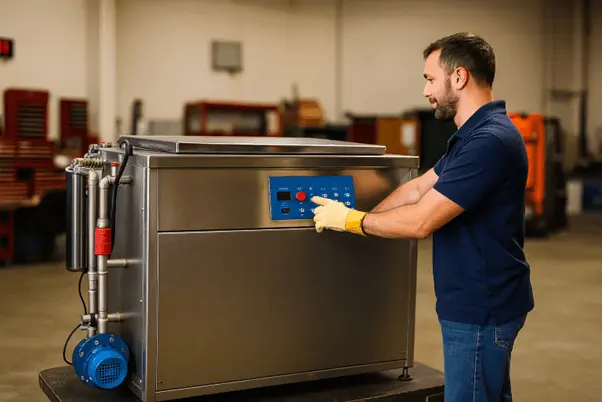
Shipyards and marine workshops have long relied on powerful chemical baths and manual scrubbing to clean engine components. However, environmental requirements are becoming stricter and attention is now turning to cleaning solutions that can meet both ecological and operational imperatives.
The Challenge of Cleaning Marine Engine Components
The internal components of marine engines operate under extreme temperatures and pressures. Fuel residues, soot, carbon deposits, and oil films accumulate on valve spindles, injectors, filters, and piston crowns. Over time, these layers harden and clog narrow channels, grooves, and hard-to-reach internal passages.
Traditional cleaning involves soaking parts in aggressive solvents, then sandblasting or brushing them by hand. It is both time-consuming and labor-intensive. The handling and disposal of strong chemicals also pose problems, making it difficult to comply with environmental regulations. In addition, manual cleaning can lead to uneven results, as complex surfaces may not be treated uniformly.
What Ultrasonic Cleaning Is and How It Works
Ultrasonic cleaning is one of many modern maritime solutions that improve working conditions and protect the environment. It uses high-frequency sound waves transmitted through a cleaning fluid to remove deposits from metal surfaces. These waves create microscopic bubbles in the fluid, which form and implode rapidly. The process, known as cavitation, produces localized pressure variations that remove soot, carbon, hardened oil residues, and other contaminants.
Since the force comes from the liquid itself, the cleaning action penetrates deep into channels, drilled passages, and internal geometries that are difficult to access with brushes or abrasive tools. This makes ultrasonic cleaning particularly suitable for parts that must maintain precise tolerances and a flawless surface finish.
The cleaning fluid used in these systems is generally an aqueous solution specially formulated for engine components, reducing the need for aggressive solvents. It can be selected based on the metals and contamination levels, without giving off strong vapors or requiring extensive neutralization after use.
Surrounding Transducer Setups and Uniform Cavitation
In modern ultrasonic cleaning systems, transducers are arranged around the tank rather than being concentrated at the bottom. By surrounding the cleaning chamber with multiple transducers, the sound waves generated penetrate the liquid simultaneously from different directions. This helps to homogenize cavitation and reduces the risk of uneven results, especially when treating large or irregularly shaped engine parts.
Some systems use elongated bar-shaped transducers instead of pointed or conical emitters. This increases the contact surface between the transducer and the tank wall, ensuring uniform energy transmission in the liquid. In addition, controlled frequency scanning prevents cavitation from forming patterns or standing wave zones. The slight frequency variation keeps the cleaning field active and dynamic, reducing dead zones and allowing the liquid to reach and act on all surfaces.
Reduced Chemical Dependency and Improved Work Environment
The switch to ultrasonic cleaning eliminates the need for harsh chemical baths traditionally used to remove heavy carbon and oil deposits. Water-based cleaning solutions designed for this process are generally milder, reducing the risks associated with corrosive solvents.
By reducing workers’ exposure to strong fumes, splashes, and hazardous waste, the method contributes to a safer and more comfortable working environment. The reduction in chemical use also simplifies the storage, treatment, and disposal of used liquids. As a result, daily tasks are streamlined and the risk of accidental exposure or environmental release is minimized.
Faster Turnaround in Workshops and Shipyards
More effective cleaning of components saves maintenance teams valuable time during engine overhauls and scheduled technical shutdowns. Ultrasonic cleaning acts simultaneously on all surfaces, removing deposits without repeated manual intervention. This reduces the number of handling operations, allowing technicians to move more quickly from inspection to reassembly.
Shorter cleaning cycles also reduce engine downtime, which is a considerable advantage for ships with tight operating schedules or shipyards that have to manage several maintenance projects at the same time. Moreover, the predictability of the cleaning process facilitates planning as its duration is independent of operator skills and pace. This optimizes workflow coordination and helps ensure reliable delivery times for maintenance work, both on board and on shore.
Practical Constraints and Maintenance Skill Requirements
Ultrasonic cleaning does not eliminate the need for repair when components show signs of wear, surface pitting, or dimensional changes. Even if a part appears free of residue, sealing surfaces, threads, and contact surfaces must be examined to determine whether reconditioning or replacement is needed. In addition, cleaning effectiveness depends on selecting the appropriate temperature range and solution concentration, as well as positioning the parts so that the fluid can reach all surfaces.
Different alloys and coatings react differently to alkaline or acidic solutions, so it is essential to match the cleaning medium to the metal and the type of deposit. Some materials may tarnish or lose their surface appearance if treated with an unsuitable mixture. Personnel performing this work are typically trained not only in the use of the equipment, but also in recognizing parts whose condition requires additional machining, polishing, or adjustment before reassembly.
About the Author